

Since January 1, 2026, road tax in Iceland works differently: every car pays a road fee for each kilometer it drives. It's called the kílómetragjald (the kilometer fee, often simply called Iceland's road tax), and it replaced the old taxes on gasoline and diesel. When you rent a car, the rental company charges it to you directly. Here's how it works, what it costs, and what to keep in mind on a winter trip.
Quick answer
- Per-kilometer fee: 6.95 ISK per km for vehicles up to 3,500 kg, whatever the fuel.
- Daily fee option for rentals: rental companies can charge 1,390 ISK per started rental day instead.
- Who pays: the rental company owes the fee to the state and charges it to you. It is not part of the Northbound total.
- Official source: island.is/kilometragjald
What is Iceland's kilometer fee (kílómetragjald)?
The kilometer fee is a charge for using the roads, based on how far a vehicle drives. Iceland's parliament, Alþingi, passed it in December 2025 as Act no. 100/2025, and it has applied to all vehicles since January 1, 2026.
The idea wasn't new. From January 1, 2024 until the end of 2025, a kilometer fee applied only to electric cars, plug-in hybrids and hydrogen cars. Since 2026, it applies to gasoline and diesel cars too.
Update: an earlier version of this article said the fee would start on July 1, 2025 at 6.7 ISK/km. The law that was finally passed set a start date of January 1, 2026 and a rate of 6.95 ISK/km.
Why did Iceland replace fuel taxes?
Fuel taxes used to pay for Iceland's roads. As more people switched to electric cars, less of that money came in, even though everyone still used the roads. A kilometer fee charges each car for how far it drives, not for the fuel it burns. So on January 1, 2026, Iceland abolished the diesel tax (olíugjald) and the excise duties on gasoline.
The carbon tax (kolefnisgjald) stayed, and it was updated for 2026. Fuel is still taxed for its emissions, but no longer to pay for the roads.
How much is road tax in Iceland in 2026?
The rate depends on the vehicle's permitted total weight, as registered, not on its fuel type:
| Vehicle (permitted total weight) | 2026 rate |
|---|---|
| Cars, SUVs and vans up to 3,500 kg | 6.95 ISK/km |
| 3,501 to 5,000 kg | 9.85 ISK/km |
| Heaviest vehicles (31,001 kg and over) | 45.17 ISK/km |
| Motorcycles up to 400 kg | 4.15 ISK/km |
Source: Act no. 100/2025, article 6; island.is/kilometragjald.
If your rental car, 4x4 or campervan is registered at 3,500 kg or less, the rate is 6.95 ISK/km. Some larger motorhomes weigh more than that, so check with the rental company if you're booking a big one.
How do you pay the kilometer fee on a rental car?
For a rental car, the law makes the rental company responsible for paying the fee to the state. The company then charges it to you.
Per-kilometer fee vs daily fee
Rental companies can charge the fee in one of two ways:
- Daily fee: For vehicles up to 3,500 kg on rental contracts of 30 days or less, the rental company can register the car on a daily fee of 1,390 ISK per started rental day. The amount is based on an estimated 200 km of driving a day. It's a fixed charge, so you pay the same however far you actually drive.
- Per-kilometer fee: 6.95 ISK for each kilometer you drive. Rentals longer than 30 days can't use the daily fee.
The fee itself carries no VAT, provided the rental shows it as a separate line on the invoice and charges it at cost. If the rental adds an admin fee for collecting it, that admin fee is subject to VAT.
Which system you get depends on the rental company, and suppliers do it differently. Your rental terms or voucher will tell you which applies.
Comparing rental quotes in 2026
Because rental companies can charge the fee per day or per kilometer, and some add an admin fee for collecting it, two quotes with the same daily rate can cost different amounts in the end. Before you compare headline prices, check how each quote handles the kilometer fee and whether there's an admin fee on top.
Example costs for a rental car trip
These examples are calculated from the official rates:
- 7-day rental on the daily fee: 7 × 1,390 ISK = 9,730 ISK
- 1,500 km on the per-kilometer fee: 1,500 × 6.95 ISK = 10,425 ISK
The two options cost the same at 200 km a day (1,390 ÷ 6.95 = 200). If you drive less than 200 km a day, the per-km fee works out cheaper. If you drive more, the daily fee does.
Where it shows up in a Northbound booking
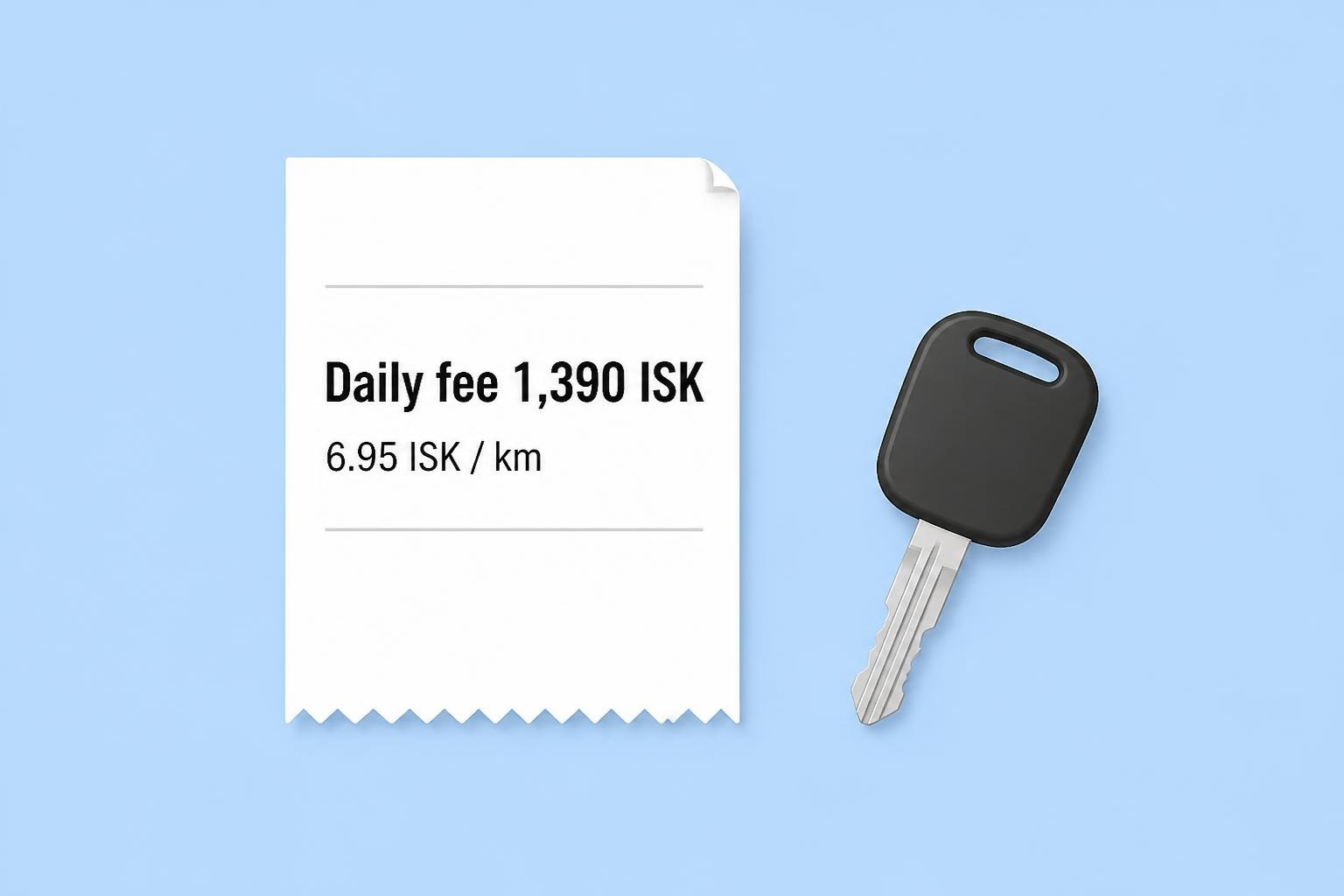
We show an estimate of the kilometer fee at checkout and on your voucher, so you know roughly what to expect before you get to the desk. There's more on our road tax help page.
Does the kilometer fee apply to electric cars and hybrids?
Yes. Since January 1, 2026, electric, hybrid, gasoline and diesel cars all pay the same weight-based rate: 6.95 ISK/km for vehicles up to 3,500 kg. The law has no separate rate for hybrids. So if your rental company offers you a hybrid or plug-in hybrid, you'll pay the same fee as for any other car.
The rules were different before 2026. In 2024 and 2025, electric and hydrogen cars paid 6 ISK/km and plug-in hybrids paid 2 ISK/km, while gasoline and diesel cars paid through fuel taxes.
So if you rent an electric car, you'll pay the same kilometer fee as for any other car. You'll still save on fuel, though. See our electric car rentals in Iceland.
What happened to fuel taxes in Iceland?
On January 1, 2026, Iceland abolished:
- the diesel tax (olíugjald), which was 77.30 ISK per liter in 2025, and
- the excise duties on gasoline (the general gasoline duty and the special fuel duty).
The carbon tax stayed. For 2026 it is 28.30 ISK per liter of diesel and 24.25 ISK per liter of gasoline.
Pump prices also depend on oil markets, the exchange rate and each fuel company, so there's no official figure for how much they changed. To budget for fuel, try our Iceland gas price calculator.
What other car taxes are there in Iceland? (bifreiðagjald vehicle tax)
Iceland also has a vehicle tax, bifreiðagjald, which the car's registered owner pays twice a year (for January to June and July to December). In 2026 it's 21,260 ISK per half-year for vehicles up to 3,500 kg, plus a surcharge for higher-emission cars. Electric and hydrogen cars pay only the minimum.
The owner pays the vehicle tax, so as a renter you don't pay it separately.
Road tax for foreign cars on the ferry
Different rules apply if you bring a foreign-registered car to Iceland, for example on the Norræna ferry. For stays of up to 30 days, cars up to 3,500 kg pay a flat fee based on the length of the stay, due on arrival:
| Length of stay | Fee |
|---|---|
| Up to 10 days | 13,900 ISK |
| 11 to 20 days | 20,850 ISK |
| 21 to 30 days | 24,325 ISK |
If you stay longer than 30 days, you pay 6.95 ISK/km on departure, minus the flat fee you paid when you arrived. Details are on island.is.
Driving in Iceland in winter: what to know
Winter days in Iceland are short and conditions can slow you down, so you may cover fewer kilometers a day than you would in summer. That's when it pays to know whether your rental uses the daily fee or the per-km fee: if you drive well under 200 km a day, the per-km fee costs less.
For a winter trip, a 4x4 with proper winter tires is a good choice. Studded tires are allowed from November 1 to April 14, and outside those dates when road conditions call for them. Compare 4x4 rentals in Iceland with winter tires.
Highland F-roads are seasonal. Most of them stay closed through winter and spring, and the Icelandic Road Administration opens each one only once the snow has cleared, usually between late May and mid-July depending on the road and the year. In winter, plan your route along the main roads, and check road conditions on umferdin.is and travel alerts on safetravel.is every day before you set off.
To plan around the weather, read our guide to the weather in Iceland and our practical guide to traveling in Iceland during high winds.
Frequently asked questions
How much is road tax in Iceland in 2026?
For cars, SUVs and vans up to 3,500 kg, the kilometer fee is 6.95 ISK/km. Rental companies can instead charge 1,390 ISK per started rental day on contracts of 30 days or less.
Is the kilometer fee included in my rental price?
No. The kilometer fee is charged by the rental company and is not part of the Northbound total. You'll see an estimate at checkout and on your voucher.
Do I pay the fee if I rent an electric car?
Yes. Since 2026, electric cars pay the same 6.95 ISK/km as other cars up to 3,500 kg, or the daily fee if the rental company uses that.
What if I drive less than 200 km a day?
On the daily fee, you pay 1,390 ISK per started rental day however far you drive. On the per-km fee, you pay only for the kilometers you drive, which works out cheaper below 200 km a day. Suppliers do this differently, so check your rental terms.
Does the kilometer fee make driving in Iceland more expensive?
Not by design. The government says the law aims to keep the cost of driving an average gasoline car about the same as before, while electric cars stay cheaper to run (Stjórnarráðið, December 2025). What you actually pay depends on how far you drive and on fuel prices.
Will the fee show up on my invoice?
On Northbound bookings, you'll see the estimated fee at checkout and on your voucher. The rental company should list it as a separate line on its invoice. The fee itself carries no VAT, but any admin fee the rental adds for collecting it does.
Do tourists pay bifreiðagjald?
No. The vehicle tax is paid by the car's registered owner, which for a rental car is the rental company.
Is the road fee included in fuel prices?
No. Since January 1, 2026, the road fee is charged per kilometer (or per day), not through fuel. Fuel still carries the carbon tax.
Final tips
- Budget 6.95 ISK/km or 1,390 ISK a day, depending on the rental.
- Check whether your rental uses the daily fee or the per-km fee, especially if you're planning short driving days.
- Look for the fee estimate at checkout and on your Northbound voucher, so it isn't a surprise at the desk.
- In winter, choose a 4x4 with winter tires and check road conditions every day.
Ready to plan your trip? Search and compare rental cars in Iceland on Northbound. Flying in? See Keflavík Airport car rental.
Official sources: island.is: kilometer fee | island.is: daily fee for rental cars | Skatturinn: kilometer fee | Act no. 100/2025 | Stjórnarráðið: kilometer fee for all cars | vegirokkarallra.is